Your AI Saves Nine Hours a Week. Your Firm Sees None of It.

TL;DR: Four independent research teams surveyed more than 11,000 executives and professionals over the past six months, and they converged on the same uncomfortable finding: most organizations report no measurable business impact from AI. The technology isn’t the problem. The firms seeing real returns rebuilt the work around the tool. Everyone else bolted AI onto a process designed for humans and declared victory.
You know this meeting. Somebody pulls up the license dashboard, adoption looks healthy, a partner mentions the summary feature saved her an hour last Tuesday. Everyone nods. And then the CFO asks the question nobody wants: where does any of this show up in the numbers?
It doesn’t. And a wave of new research says your firm has a lot of company.
Nine in ten executives report nothing
An NBER working paper released in February surveyed nearly 6,000 senior executives across the US, UK, Germany, and Australia. The headline finding: nine in ten report no impact from AI on employment or productivity at their own firms over the past three years.
Read that again. Not “modest impact.” Not “impact we’re still quantifying.” Nothing. Zip. Zilch. Nada.
My first instinct was to write this off as one weird sample. Then I went looking for a survey that contradicted it and couldn’t find one. McKinsey’s latest State of AI research, roughly 2,000 organizations, found only 39 percent could attribute any bottom-line impact to AI at all, and most of those pegged it below 5 percent of earnings. Writer surveyed 2,400 executives and employees this spring and landed at 29 percent seeing significant ROI from generative AI. Even the narrow ones agree (Gartner asked 114 HR leaders and got 88 percent reporting no significant business value). I kept waiting for one of these to break the pattern. None did.
Here’s the detail from the NBER paper that stopped me, though. Two thirds of those executives personally use AI. Their average usage: 1.5 hours a week.
An hour and a half. A week. That’s not a technology strategy. That’s a browser tab.
The “not yet” problem, and why it should worry you more
Now, the honest read of this data is not “AI doesn’t work.” The same NBER executives who report zero impact so far predict sizable gains over the next three years: productivity up, output up, headcount down. They believe the value is coming. They just haven’t seen it land yet.
Which raises the real question. If the technology is this capable, and everyone believes in it, why hasn’t it landed?
The Writer survey gets closest to an answer, almost by accident. Individual AI super-users in that study are five times more productive than their slower colleagues. They save about nine hours a week. Real, measurable, at the level of one person. And yet only 29 percent of their organizations see significant ROI.
So the gains exist. They’re just evaporating somewhere between the individual and the P&L.
I’ve watched this happen inside law firms for two years now. An associate uses AI to cut a first draft from four hours to forty minutes. Great. Then the draft sits in the same review queue, goes through the same three-partner sign-off, gets billed against the same hourly assumptions, and lands on the client’s desk on the same day it would have anyway. The associate got faster. The matter didn’t. The firm captured none of it.
That’s not a tool failure. That’s a workflow that was never redesigned to absorb the speed.
What the winners actually did differently
McKinsey’s data puts a number on this. Their AI high performers, the roughly 6 percent of organizations attributing meaningful earnings impact to AI, are nearly three times as likely as everyone else to have fundamentally redesigned their workflows. Of the 31 organizational factors McKinsey tested, workflow redesign ranked among the strongest predictors of actual business impact. Not model choice. Not spend. The rebuild.
And the losing pattern has a name too. Writer found that 75 percent of executives admit their company’s AI strategy is “more for show” than actual guidance. Seventy-five percent. These are the same leaders approving seven-figure AI budgets, by the way; 59 percent of surveyed companies spend over a million dollars a year on this.
So here’s how I’ve started putting it to firms: buying the tool is the easy 20 percent. The value lives in the other 80 percent, which is the part nobody wants to do. Mapping how work actually flows through your firm. This is where I’m personally spending the bulk of my time with clients. Deciding what a matter looks like when drafting takes minutes instead of hours. Changing who reviews what, and eventually, though nobody wants to say it out loud yet, confronting what all this does to the billable hour. That work is political. It steps on toes. It has no launch party.
Which is exactly why so few firms do it, and exactly why it’s where the advantage sits.
One more data point, because it explains a lot. Thomson Reuters’ 2026 professional services report found only 18 percent of organizations even track ROI on their AI tools. Roughly the same as last year. You can’t capture value you refuse to measure. Most firms haven’t skipped the redesign because they tried it and failed. They’ve skipped it because nobody’s looking.
The fair objections
A managing partner pushed back on me recently with a version of this: redesigning workflows mid-year, with paying clients in the pipeline, is expensive and risky, and the models keep changing anyway. Why rebuild around a tool that looks different in six months?
It’s a fair point, and partly right. If you’d rebuilt your intake process around the best model of early 2024, you’d have rebuilt it again by now. Redesign has a shelf life.
But notice what that argument assumes: that the redesign is about the tool. It isn’t. The durable work is mapping your processes, measuring your baselines, and deciding which handoffs exist because they add judgment versus which exist because they always have. That analysis survives every model release. The firms doing it now will swap tools in and out for a decade. The firms waiting for the technology to “settle” are waiting for a day that isn’t coming.
The other objection is quieter: maybe zero measured impact is fine, because the individual time savings are real even if finance can’t see them. Maybe. For about another year. Then your competitor prices a matter based on their rebuilt cost structure, and you find out what “we couldn’t measure it” actually cost.
What to do Monday morning
Pick one workflow, not one tool. Take a single high-volume process, intake, first-draft discovery responses, monthly reporting, whatever hurts, and map every step and handoff. Then ask which steps exist only because a human used to do the prior step slowly.
Set the baseline before you touch anything. Hours per matter, turnaround time, review cycles, write-offs. If only 18 percent of organizations track AI ROI, being in that 18 percent is one of the cheapest advantages available right now.
Rebuild the one workflow end to end, and measure again in 90 days. Not a pilot. Not a lunch-and-learn. Change the actual sequence of who does what, let the numbers tell you whether it worked, then take the playbook to workflow number two.
That’s it. Unglamorous on purpose. The nine-in-ten firms reporting nothing didn’t fail at AI. Most of them never actually started.
The tool was never the moat. The rebuild is.
If you enjoyed this, please share it with others. Here’s a couple of shots of Magnus from the last 24 hours.
Chilling on the couch with his favorite Lammie toy:

Breakfast of champions: lemon loaf cake with whip cream (thanks, Coffee Bean!).

Lunch. Filet mignon. Costco’s finest ;)
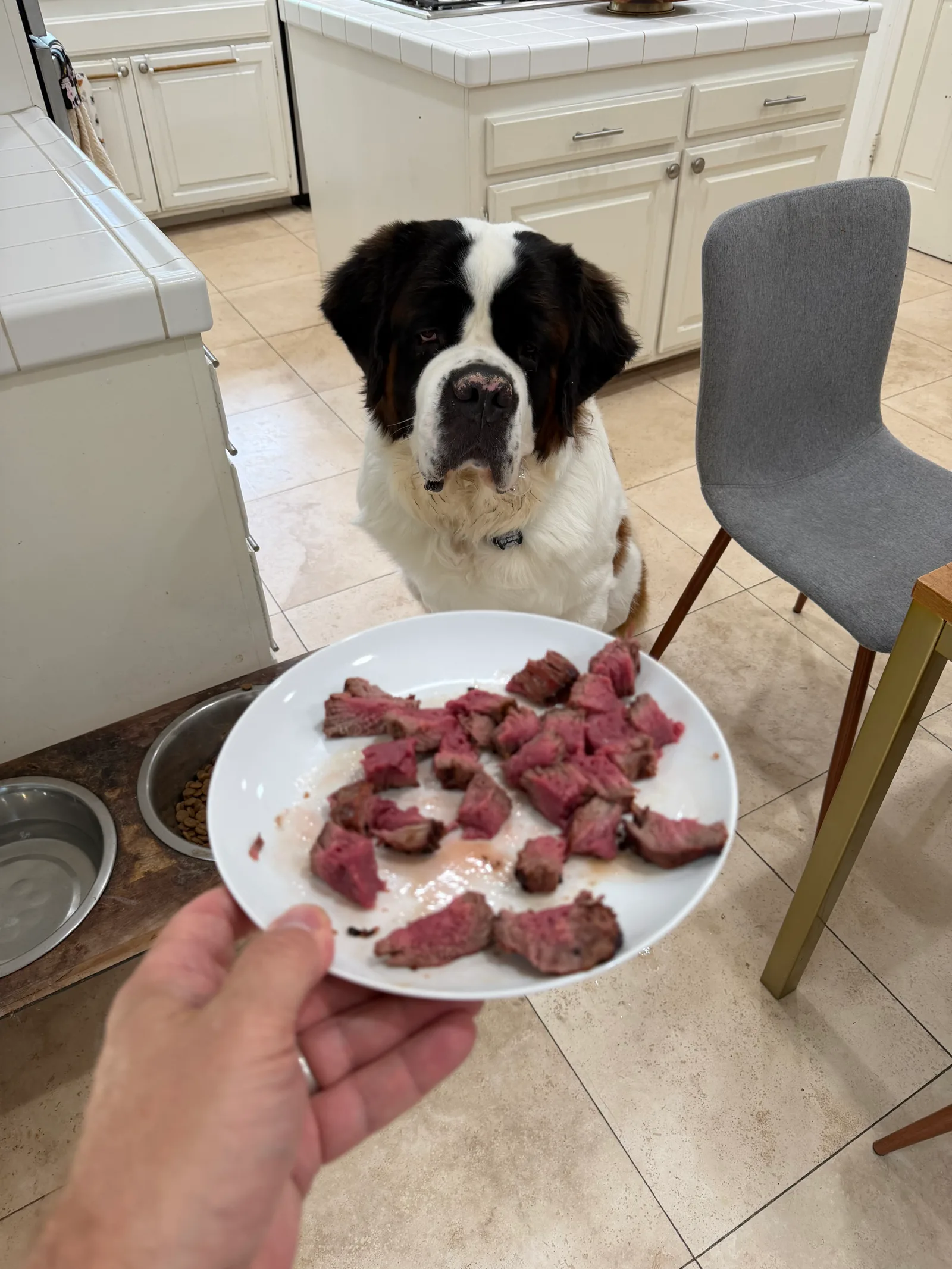
So glad he’s not spoiled.