Google I/O 2025: The Renaissance of Innovation and Why It Matters to Your Business
I had the privilege of attending Google I/O 2025 yesterday, and I can confidently say: Google is back in a big way. The energy at Shoreline Amphitheater was electric as Google unveiled a staggering array of AI innovations that will fundamentally reshape how businesses operate. After years of playing catch-up in the AI race, Google has reclaimed its position at the forefront of technological innovation.
Here is a quick summary of some of the key announcements. Over the next two weeks, I will deep dive into these areas to discuss why they are so important and matter to your business operations, customer experience, and competitive advantage.
The Next Generation of AI: Gemini 2.5
The show's star was undoubtedly Gemini 2.5, Google's most advanced AI model yet, arriving in two distinct flavors designed for different business needs.
Gemini 2.5 Pro with Deep Think represents a fundamental shift in how AI approaches complex problems. Instead of generating a single answer quickly, Deep Think runs multiple reasoning paths in parallel – essentially considering different approaches to a problem before selecting the most accurate one. In my conversations with Google engineers, they explained that this mimics how human experts tackle complex issues by considering multiple hypotheses before concluding.
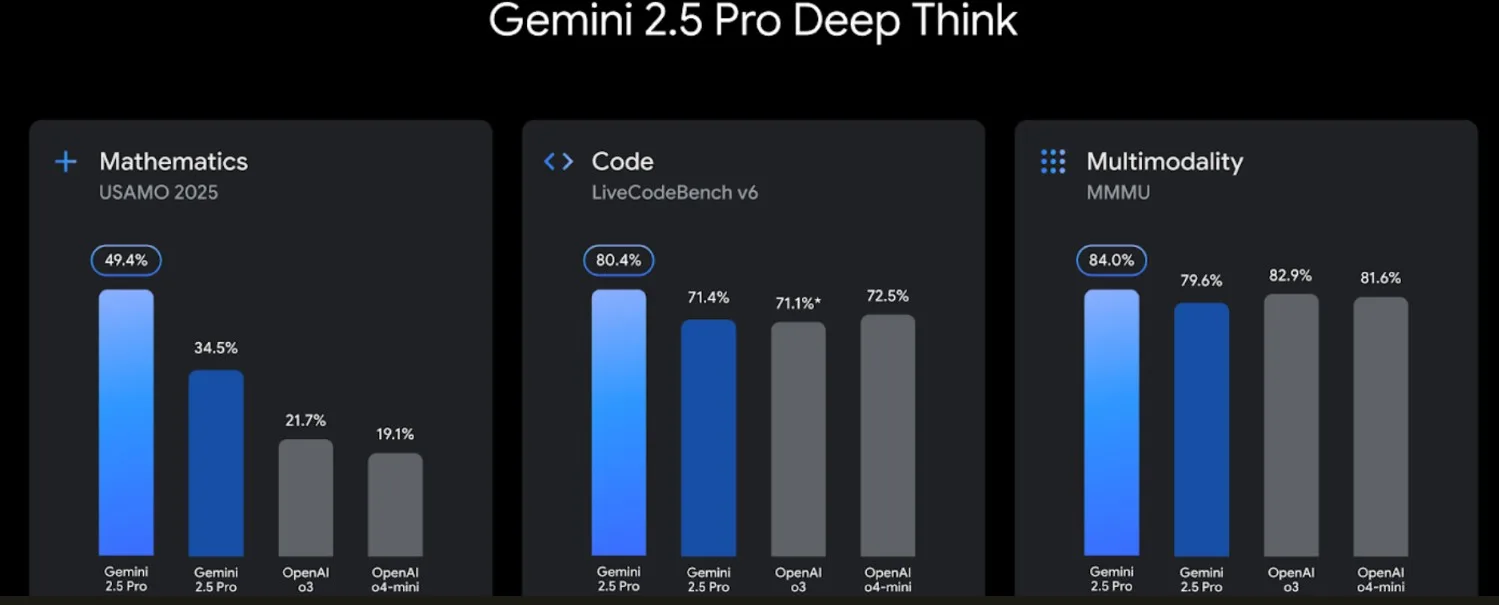
The performance and progress are incredible. Highlighting USAMO, which is a very challenging set of held-out math problems, we're now at 49% accuracy. This is equivalent to the top quartile of entrants. Progress is fast month-by-month, back in March we were at 24% (2.5 Pro preview), and our best Thinking model from Jan (2.0 Flash Thinking) was at 6%.
Gemini 2.5 Flash takes a different approach, optimized for speed and efficiency with improved thought summaries for transparency. You'll want this model for customer-facing applications, rapid data analysis, and collaborative workflows where responsiveness is key. The addition of thought summaries is particularly valuable for business users who need to understand the AI's decision-making process for compliance and governance purposes.
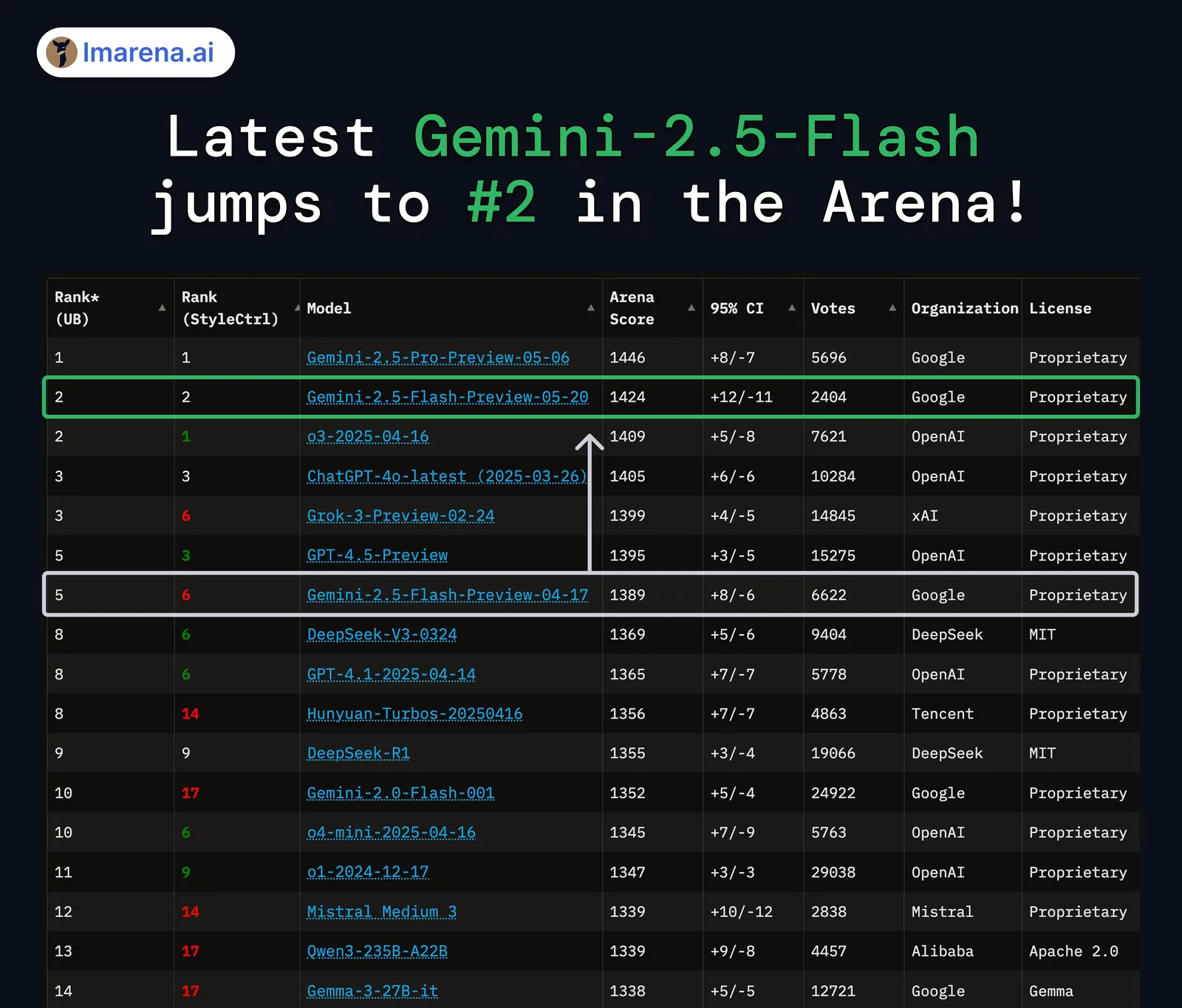
What impressed me most was how these two models complement each other, giving businesses the flexibility to deploy the right AI for each specific need rather than forcing a one-size-fits-all approach. The new Gemini 2.5 Flash has shockingly good performance. In fact, on LMArena it jumped five spots to take the #2 spot (just behind Gemini 2.5 Pro). Putting it ahead of the full OpenAI o3 model, ChatGPT 4o (latest), Grok 3, and even the ChatGPT 4.5 preview. Amazing for a flash model.
Creative AI: Redefined for Business
Google's creative AI announcements were equally impressive, with clear applications beyond just marketing departments.
Veo 3 takes video generation to new heights with 4K realism and native audio, dialog, and noise synthesis. What makes this particularly valuable for businesses is the integration with Flow, a new filmmaking tool that combines Veo 3 with Gemini to build complete scenes from text prompts.
Imagen 4 complements this creative suite with 2K image generation that's notably better at typography and text in images, addressing a major pain point for businesses creating visual assets at scale.
Flow is a new AI filmmaking tool that combines the best of Veo, Imagen, and Gemini.
Lyria 2: AI tools for professional musicians, AND available on YT shorts, Vertex AI, and Music AI sandbox.
Search and Shopping: A Whole New Level of Integration
AI Mode in Search brings deeper Gemini integration with interactive capabilities, charts, and shopping features directly into search results. For businesses, this means adapting SEO strategies to optimize for these AI-enhanced results and exploring new ways to connect with customers through this interface.
Gemini in Chrome enables contextual website assistance directly in the browser, creating opportunities for enhanced customer support and guided experiences on company websites.
Project Beam, a successor to Starline, introduces advanced 3D video telephony with HP hardware, potentially transforming remote meetings and customer interactions.
Project Astra provides a proactive multimodal assistant that can see, hear, and speak, opening new frontiers in automated customer service and operations assistance.
Real-time translation in Google Meet eliminates language barriers in business communications, an essential capability for global organizations.
Google Search Try-On lets you virtually try clothes on and then buy with one click.
There is so much more
One of my personal favorites was the new glasses with Android XR. I had the opportunity to try these on and sample them, and it is an incredible experience. Sight, sound, and the full power of Gemini in a pair of lightweight glasses (here's a shot of me trying them out).

There was also:
Agent Mode
Gemini Diffusion
Gemini native audio
Jules Code Assistant
Upload your own files into Deep Research
Create video content from NotebookLM
Canvas updates
Native audio updates
MCP integration
Over the next two weeks, I'm going to deep dive into a large number of these for you.
Conclusion: A New Chapter Begins
What I witnessed yesterday at Google I/O 2025 wasn't just a collection of product announcements but the unveiling of a comprehensive vision for business transformation through AI. Google has clearly invested enormous resources in building practical tools that address real business challenges rather than merely demonstrating technological capabilities.
The race to incorporate these innovations into business operations will define winners and losers across industries in the coming years. The good news is that Google has designed these tools with accessibility and practical application in mind, creating opportunities for organizations regardless of size or technical sophistication.
The future of business arrived today. The only question is how quickly we'll adapt to embrace it.