Claude - it's time to revamp our sales compensation plans!

Fall is here. The temperature is dropping, the leaves are changing colors, you can comfortably wear your sweater again, and college football is going strong (Go Ducks!). This is also the time of year when our attention turns to sales compensation plans for the next year. According to a 2023 survey from CaptivateIQ, 80% of companies adjust their sales compensation plans annually. There are a number of reasons that companies do this - some of the more common reasons include:
Changes in the competitive landscape: Companies may need to adjust their sales compensation plans to remain competitive in the market, as other companies may offer more competitive salaries and commissions.
Changes in the company's sales goals: If the company's sales goals change, it may need to adjust its sales compensation plans to reflect these changes.
Feedback from sales reps: Companies may adjust their sales compensation plans based on feedback from their sales reps. For example, if sales reps find it difficult to meet their quotas, the company may adjust the quotas or the commission structure.
Every year, it’s important to look at your plans to make sure they are effective and fair. We want to attract and retain our top sales talent, motivate the reps to hit our goals, and ultimately boost sales for the company.
As you develop your plans for the year, I encourage you to leverage the power of AI to help you analyze the impact of any changes you are making. The best tool I have found to use for this is Claude (claude.ai). Claude can process very large text documents (100K tokens or about 75K words). It can ingest your entire sales compensation plan and then analyze, make recommendations, and even compare plans year over year.
LEVERAGING AI TO HELP BUILD SALES COMPENSATION PLANS
For purposes of this example, I’ve created a simple 2024 sales compensation doc that includes the following information:
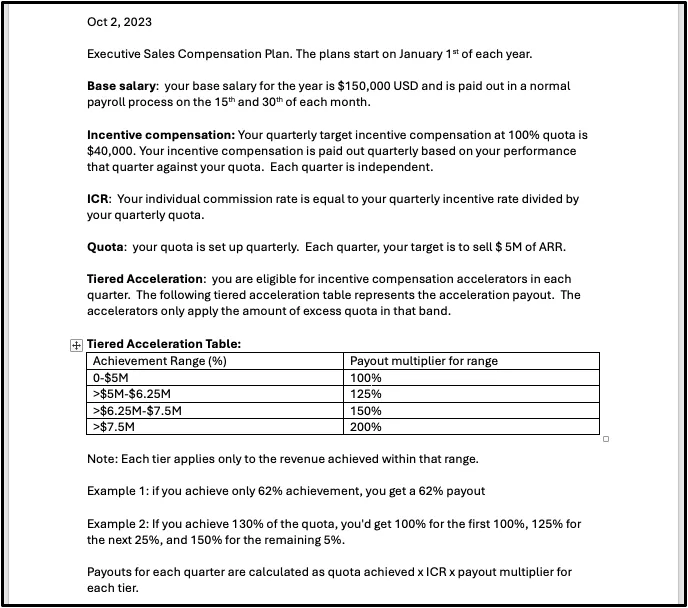
This file is saved as a Word doc, and I can upload it directly to Claude. An important note: when you are asking Claude to do analysis for you, make sure that you tell it to calculate every step (in this case, I’m asking it to make sure it calculates every tier in the tiered accelerator table).
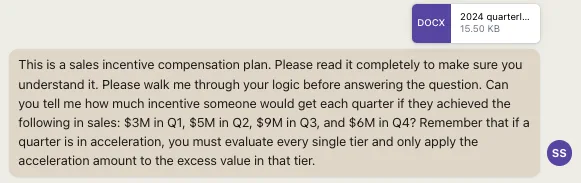
I had set a $5M ARR/quarter target. So, looking at the input, the salesperson came below plan in Q1, at plan in Q2, significantly above plan in Q3, and above plan in Q4. Here’s the output I get from Claude:
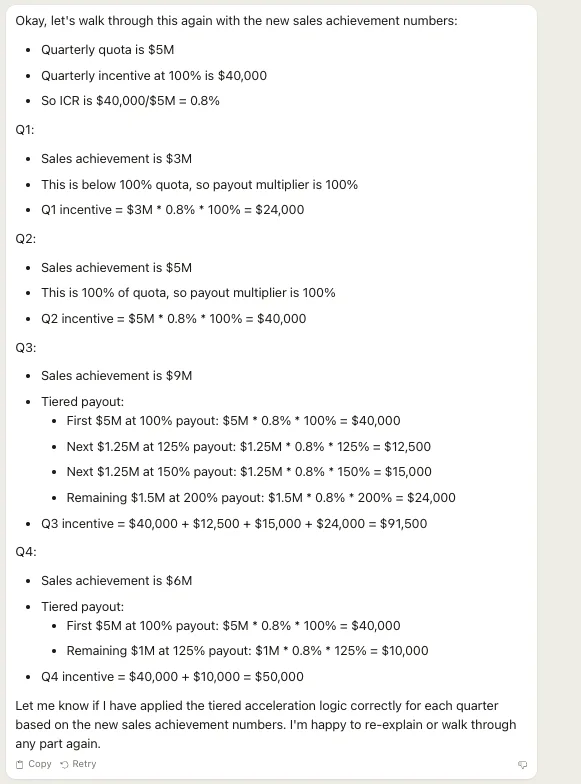
Note that the calculations for Q3 were tricky because it had to calculate accelerator payouts across multiple tiers. This is why it’s important to tell Claude to be very specific when running the calculations.
Now, let’s say that you’re ready to pitch this new plan to the sales team. It’s always fun trying to show the team that the new plan is better than the old plan (which is not always the case). If our old 2023 plan (last year) looked like this:
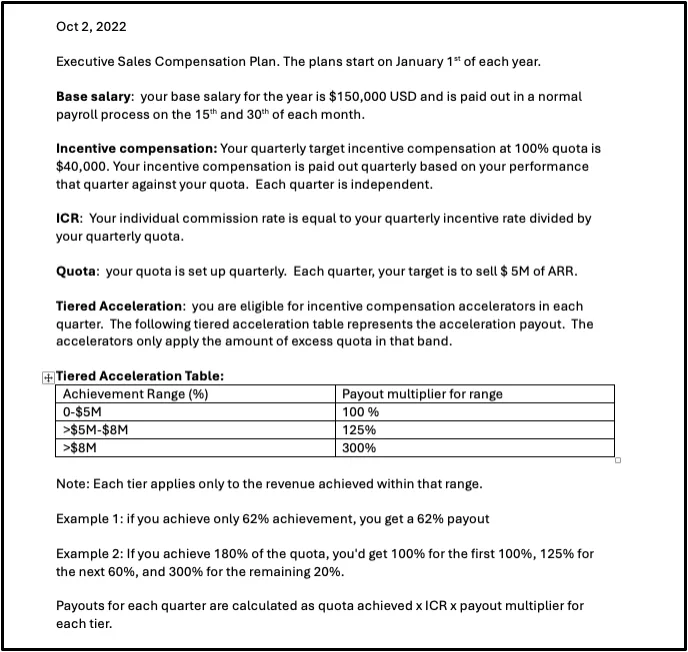
The big change is the acceleration table. We went from three tiers in 2023 to four tiers in 2024, and we changed the percentage payouts.
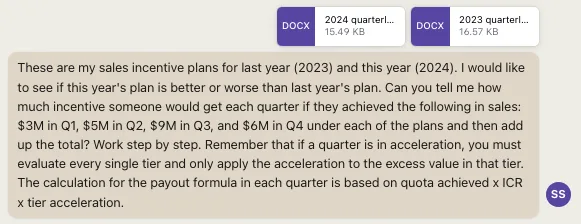
Let’s ask Claude to compare both plans and run the same sets of numbers to see how things look:
Here’s the resulting output:
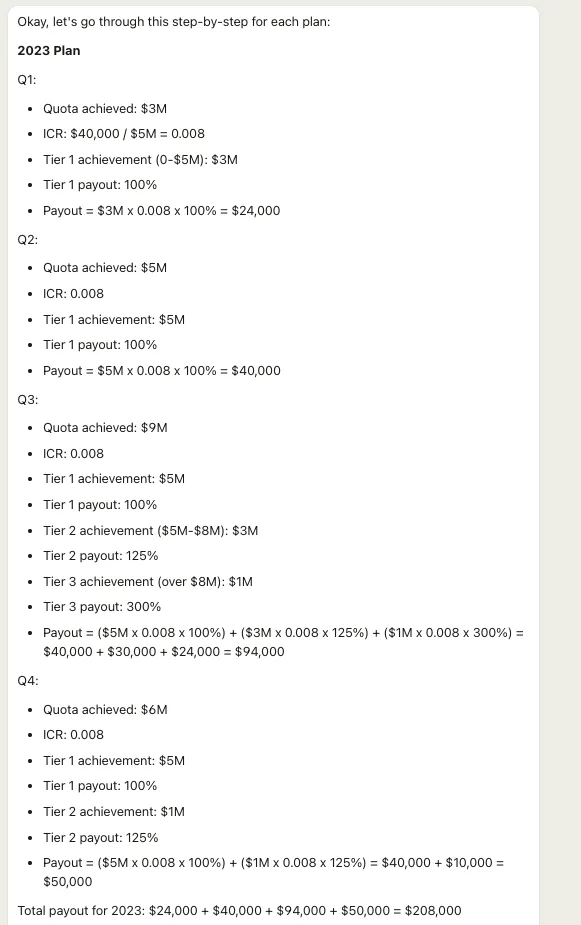
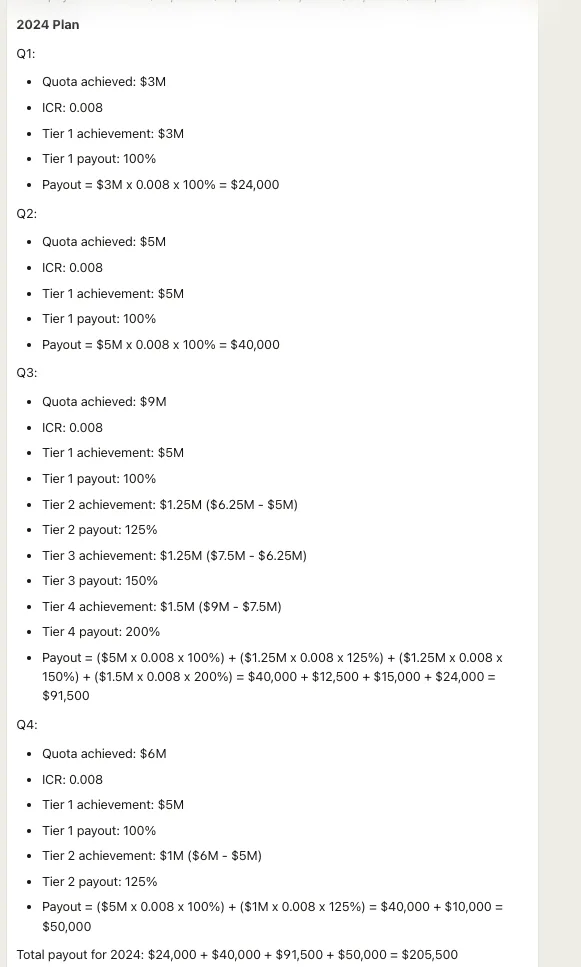

This is a really good way to compare plans year over year and run lots of different scenarios to see how the plan looks at various levels of achievement. The team might have originally thought that the 2024 plan was better, but this shows them that the acceleration last year would have paid out more for the salesperson.
One last thing I asked Claude to do was make recommendations for improving the 2024 plan. I asked, “Is there anything you would change in the 2024 compensation plan that you think could make it better?”
Here’s what Claude came back with:
Here are some potential changes I would consider to try to improve the 2024 incentive compensation plan:
Increase the tiers and accelerators to provide more upside for exceeding quotas by higher amounts. For example, could add additional tiers at 200%+ payout for achievements significantly above quota.
Adjust tier thresholds - the current thresholds at 125% and 150% may be too high. The first tier threshold could be lowered to 110% or 115% to provide accelerators earlier.
Consider uncapped accelerators above a certain threshold (e.g. 300% payout above 150% of quota) to really reward top performance.
Add a tier with accelerators below 100% quota achievement (e.g. 80-100% achievement) to drive performance for meeting most of the quota.
Consider team/group goals to incentivize collaboration in addition to individual goals.
Allow for adjusting quotas mid-year if business conditions change.
Offer a choice of cash vs. equity compensation at higher tiers to align with company goals.
Allow rollover of excess achievement for accelerators in future quarters to smooth out performance.
The key is balancing driving high performance with goals that are achievable. I'd want to run modeling on different options to see the impact and incentivize the right behaviors. But overall, increasing accelerators and tiers could improve the plan.
WRAPPING UP
IMPORTANT: Your wording in the prompts matters a lot. If you aren’t careful, you will get incorrect calculations. Always check the output of Claude, ChatGPT, Bing, Bard, etc.
When creating compensation plans, it’s important to be incredibly thoughtful about how you are crafting the plan as you’re dealing with how people get paid. You want compensation plans to be transparent and easy to understand. You want them to be fair and equitable, and you absolutely want to reward top performance. You have a new tool available this year to help, and I encourage all of you to take advantage of it.
As always, this post ends with a photo of Ollie doing one of his favorite activities – napping under a blanket.

If you have any questions, please reach out at any time.
Best,
Steve